Choosing my life insurance - part 1
09 Jan 2026 | #japan | #money | #insuranceI wrote about the types of life insurance a while back and recently decided to sign up for one. In this post I will share my process of choosing it. Well, the first half of it, because in the end I couldn’t completed the sign-up online.
Type of insurance: Income Protection Insurance (収入保障保険)
I reviewed the types of life insurances earlier and found this to be the best match for my needs: it is a term life insurance that pays out monthly payments until the end of the term. So essentially: I pay a monthly fee from now until I turn 60, and in exchange if I die within this time period, then my family gets a monthly payment every month until I would be 60. Compared to regular term life insurance (with a lump sum payment) this is a decreasing coverage: if I die late, then it pays much less than if I die early. However this matches the needs of my family better, and it keeps the premiums reasonable (since the chance of me dying early is far lower than when I’m near 60).
Moreover I really like that it is easy to manage for my family: getting a lump sum and trying to live off of it can be stressful (how do you invest it, how much do you spend, what if markets go down or yen gets stronger), especially in an already very stressful time. Simply getting monthly payments alleviates this problem.
I also looked into disability insurance but decided not to get one.
Taxes on life insurance
I covered it in a previous post, but TLDR: as long I pay for my life insurance and my family gets it, then it is taxed as inheritance. For income protection insurance (since it’s an annuity) they calculate the present value, tax that as inheritance then treat it sort of like an investment: part of the payouts are principal (tax-free at payout) part is interest (taxed as miscellaneous income).
The inheritance part of this can be an issue: the heirs might be on the hook for inheritance tax on the future payments, but not have the money at hand. Unless someone has a lot of illiquid assets (e.g. real estate), I don’t think this would be a problem: for example with a 200,000 yen per month annuity, even if it pays out for the 28 years, the sum of all payouts would be 67.2 million yen (6,720万円). Only part of this would be in scope for inheritance, but even the full amount would be less than the spousal 160 million yen tax credit.
Sizing
So how much insurance to get? More feels better, but it’s important to keep in mind that insurance is a negative sum game (on average you will pay more than the benefits you receive - otherwise the insurance companies would go bankrupt), so it is best to limit the insurance to the catastrophic events, and invest the extra premiums that this saves.
Deciding the amount of insurance has an issue: both the premiums and the payouts are fixed in nominal terms and don’t take inflation into account. So e.g. if I conclude that my family would need 200,000 yen per month today, then in 20 years from now the same need would be appr. 300,000 yen (assuming a 2% inflation which is the target of BOJ). Thus a bit of oversizing is a good idea.
With this in mind I decided to get a coverage for 300,000 yen per month.
Term
I decided to get the insurance until I turn 60. By that time all of my kids will be in their mid-late twenties and should be independent. I could have pushed it to 65, but that last 5 years are more risky, making the premiums higher, while I don’t have a strong need for insurance during that period.
Guaranteed Minimum Payment Period (最低支払保証期間)
Another option to choose is the Guaranteed Minimum Payment Period (最低支払保証期間): if someone dies towards the very end of their term, the heirs would receive only a few months of coverage. To avoid this, most income protection insurance offers 1, 2, 5, or 10 year minimum payment period options, so even if there is less than that left from the term, it will still pay out for that long. I don’t think this is needed: if I die right before 60, I should have enough saved for retirement to make this life insurance unnecessary, so I will choose one of the lowest available option (if 1 and 2 years have the same premium, I might go with 2).
Choosing the company
My favorite comparison website, kakaku.com has a comparison page for income protection insurance. However many companies are missing, so I also did some Google search and asked ChatGPT.
Most companies require an in-person or phone interview before sining up for an insurance. I found only 3 that allows online sign-ups and offer income protection insurance:
- FWD Life (FWD生命) - part of the Hong Kong-based FWD Group
- Orix (オリックス生命) - part of the Japanese ORIX Group
- Hanasaku Life (はなさく生命) - owned by 日本生命保険相互会社 (Nippon Life Insurance Co.)
Orix would only offer up to 150,000 yen per month payout, so they were out.
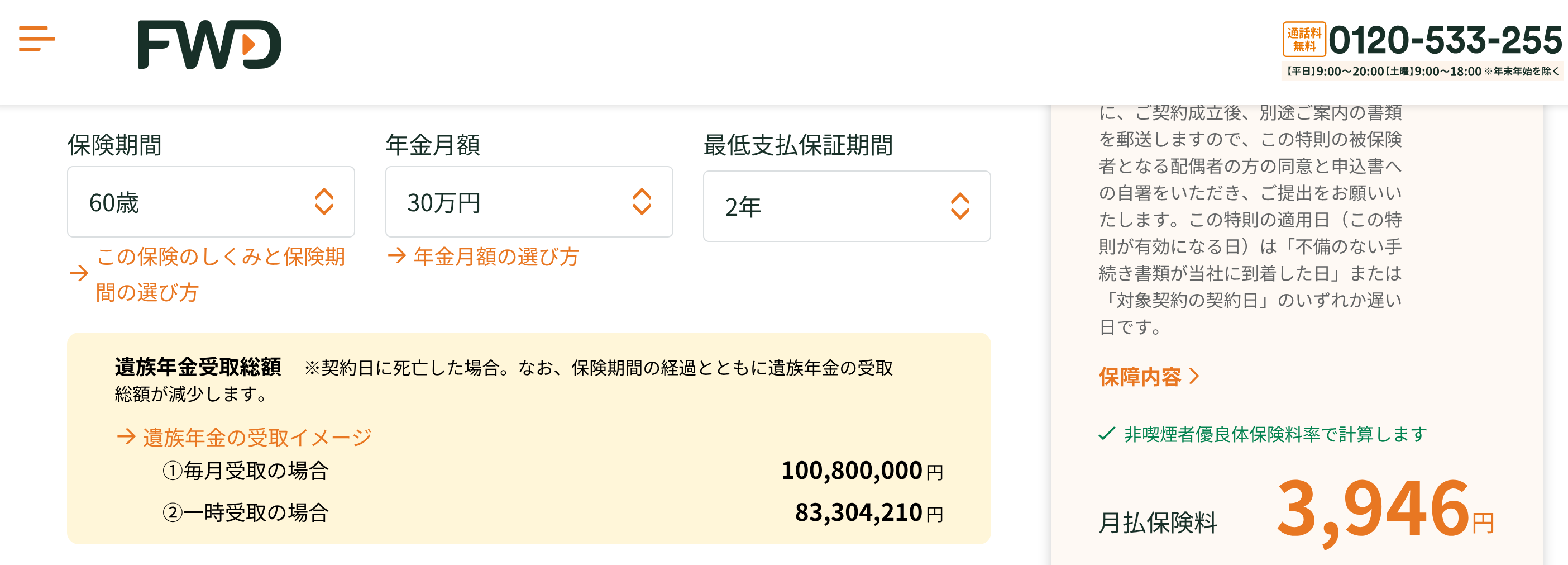
FWD Life offered it for a monthly premium of 3,946 yen.
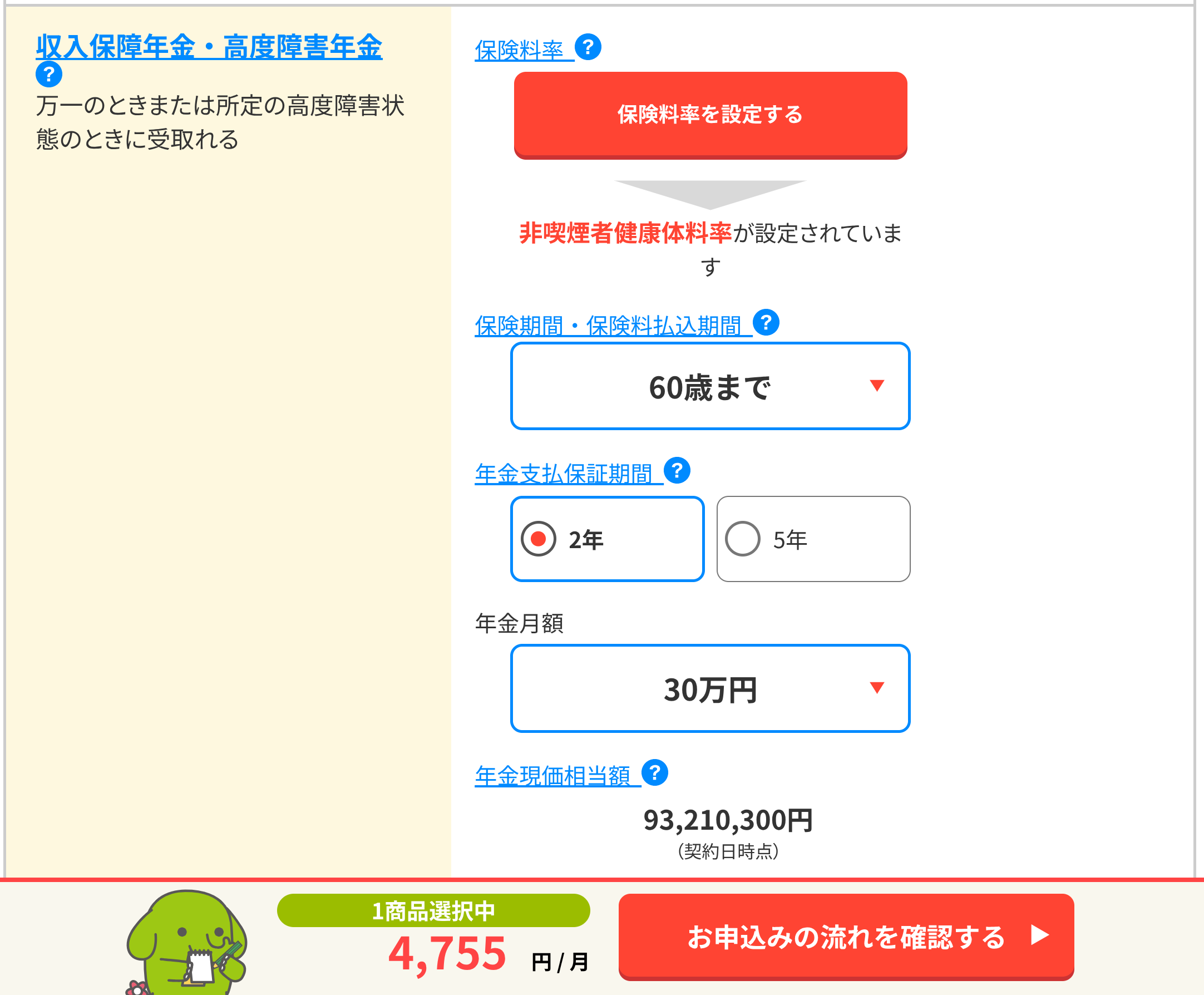
while Hanasaku Life offered it for a premium of 4,755 yen.
I was initially a bit concerned that FWD is owned by a Hong Kong-based entity, so if the Japan-China relationship deteriorates further, then it could be affected, but the insurance is offered by the Japanese subsidiary and thus regulated by the Japanese laws, so should be fine.
Meanwhile Hanasaku has a website that looks a bit like a nursery’s website and the footer says Copyright © 2021 Hanasaku Life Insurance Co. which doesn’t exactly instill confidence.
FWD is meaningfully cheaper too, so I decided to go with FWD.
Fine-tuning the options for fun
I already decided my coverage, but just for fun I checked a few combinations:
| Parameters | Monthly premium | Premium diff | Premium diff % |
|---|---|---|---|
| Base-case: 300,000 yen payout, until 60, 2 year guaranteed, healthy discount, non-smoker discount, no options | ¥3,946 | ¥0 | 0% |
| Half payout: 150,000 yen | ¥2,024 | -¥1,922 | -49% |
| Going until 65 (5 extra years) | ¥5,174 | ¥1,228 | 31% |
| Going until 70 (10 extra years) | ¥6,780 | ¥2,834 | 72% |
| Going until 80 (20 extra years, the maximum offered) | ¥11,508 | ¥7,562 | 192% |
| Guaranteed 5 year payout | ¥4,111 | ¥165 | 4% |
| Guaranteed 10 year payout | ¥4,634 | ¥688 | 17% |
| Non-healthy body (BMI outside 18-27 or blood pressure over 140/90) | ¥6,985 | ¥3,039 | 77% |
| Smoking | ¥5,601 | ¥1,655 | 42% |
| Smoking and unhealthy body | ¥9,164 | ¥5,218 | 132% |
| Being a woman | ¥3,581 | -¥365 | -9% |
| Add-on for disability insurance (生活支援特則): it will start paying the annuity if the insured becomes disabled or require nursing care | ¥8,447 | ¥4,501 | 114% |
| Add-on for 3-major illness premium exemption (3大疾病保険料込免除特約): if diagnosed with cancer, heart disase, or stroke, you don’t have to pay for the insurance going forward | ¥4,184 | ¥238 | 6% |
| Add-on for Spouse Simultaneous Accidental Death Increase Rider (配偶者同時災害死亡時割増特則) | ¥3,946 | ¥0 | 0% |
No big surprises here. Some options feel pretty cheap, e.g. increasing the minimum payout period, but those extra costs still add up, so if I don’t need it, I won’t get it.
Add-on for Spouse Simultaneous Accidental Death Increase Rider (配偶者同時災害死亡時割増特則) is different: this is for free, and it doubles the payout if both me and my spouse dies in the same accident (disease is excluded, only accident). The chance of this is super low (and that’s why it’s free), but since it’s free I decided to add it.
Online sign-up: failed
I continued with FWD to do the online sign-up. The form had a bunch of questions, one of them being:
以下の臓器や検査の異常を指摘されたことがありますか。(要再検査・要精密検査・要治療を含みます。なお、再検査等の結果で異常がなかった場合も含みます。) ■心臓 ■肺 ■胃腸 ■肝臓 ■腎臓 ■すい臓 ■胆のう ■子宮 ■乳房 ■診察 ■血圧測定 ■尿検査 ■血液検査 ■肝炎ウイルス検査 ■便潜血検査 ■眼底検査 ■胸部レントゲン検査 ■上部消化管レントゲン検査 ■内視鏡検査 ■細胞診 ■組織診 ■認知機能検査 ■腹部超音波検査 ■CT検査 ■MRI検査 ■PET検診 ■しゅようマーカー(CEA・AFP・CA19-9・PSA等)
which translates to
Have you ever been told that there are any abnormalities in the following organs or tests? (This includes cases where re-examination, detailed examination, or treatment is required. It also includes cases where no abnormalities are found in the results of re-examination, etc.) ■ Heart ■ Lungs ■ Gastrointestinal system ■ Liver ■ Kidneys ■ Pancreas ■ Gallbladder ■ Uterus ■ Breasts ■ Physical examination ■ Blood pressure ■ Urine test ■ Blood test ■ Hepatitis virus test ■ Fecal occult blood test ■ Fundus examination ■ Chest X-ray ■ Upper gastrointestinal X-ray ■ Endoscopy ■ Cytology ■ Histology ■ Cognitive function test ■ Abdominal ultrasound ■ CT scan ■ MRI scan ■ PET screening ■ Tumor markers (CEA, AFP, CA19-9, PSA, etc.)
Unfortunately I have to answer yes to this. Every year when I do the company health check I get a B grade for my heart as my resting heart beat is too low (bradycardia). I went to cardiologist to look into this, and the conclusion was that I have Athlete’s Heart: I have been running and cycling a lot, so when I’m sitting at the clinic (especially after I had to skip my breakfast and coffee), my heart beat is below the normal range. With my background this is expected and not something to worry about, but it still results in a B grade which translates to “minor abnormalities, no need for concern”.
After saying yes to the above question, the site told me to call them as I can’t do the sign-up online, and they want to hear the details of the abnormalities. My Japanese is not good enough to explain this over the phone though, so I will find another option.
Alternative 1: try Hanasaku
They were more expensive, but otherwise looked good (sans the website design), and their application flow doesn’t have the same question. However they also require uploading the health check results, so there is a chance they would have the same question.
Alternative 2: go to an insurance broker in person
I’m better explaining things in person than on the phone, and it seems that the main way life insurance is sold in Japan is through insurance brokers (which is also why most providers don’t allow online sign-ups). So my plan is to give that a try and see. The biggest risk here is that legally I have to fully understand the contract I’m signing, and if they want to be very strict about that, then they might reject my application. I hope that by doing my homework and going prepared, I can convince them that I understand it as well as their regular customers (who probably also don’t understand every single technical term in it). Or that they are willing to bend the rules, since they are probably paid by commission on closed sales, so as long as I’m not a risk for them, they might decide to be helpful.
Continue with part 2 here.
